Paris: The Monumental Axes, Seine Banks & Montmartre Butte
Examining France's dense metropolitan capital through its primary urban concentrations: the Champ de Mars, the historic royal palace quadrant, and the elevated 18th arrondissement.
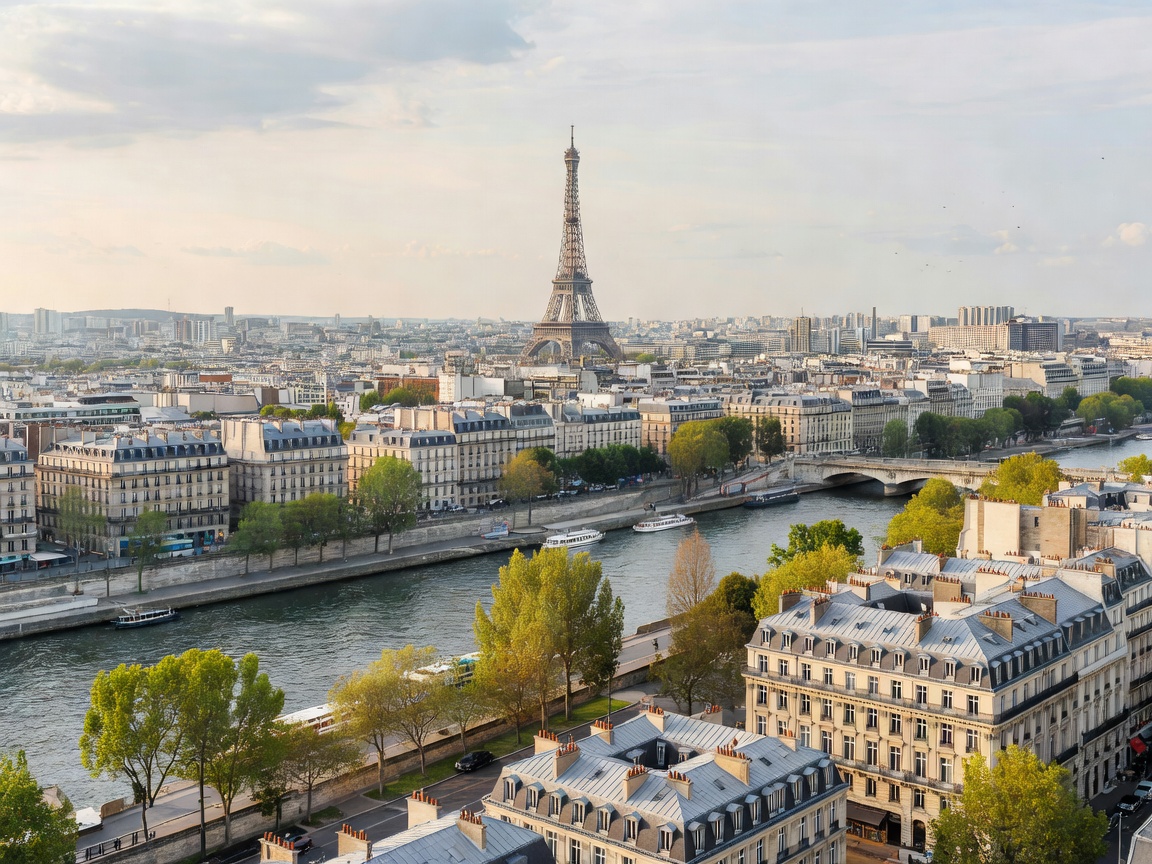
The Structural Layering of the Capital
Paris cannot be reduced to a singular atmospheric stroll. The city is a tightly articulated grid of twenty administrative arrondissements, shaped radically by Baron Haussmann’s nineteenth-century urban clearances, the medieval spine of the Île de la Cité, and the peripheral former villages annexed in 1860. Understanding this structural topography allows travelers to balance intense monument visits with genuine urban texture.
1. The Monumental Ironwork: Champ de Mars & Eiffel Tower
Erected as the provisional centerpiece for the 1889 Exposition Universelle, the 330-meter puddled-iron tower designed by Gustave Eiffel’s engineering firm remains the preeminent landmark of the 7th arrondissement. The surrounding Champ de Mars stretches southeast toward the École Militaire, offering formal axial viewpoints lined with manicured chestnut trees.
Operational Assessment: The monument operates across three public levels. The first and second platforms are accessible via stairways (674 steps to level two) or hydraulic and electric lifts; the summit requires dedicated elevator transfer from the second floor. Security perimeters enclose the base, demanding timed-slot reservations during peak periods between April and October.
Logistical Consideration: Eiffel Ascent Modes
Stairway ascents reduce waiting queues significantly and provide an intimate perspective on Eiffel’s cross-braced iron lattices, but require moderate physical stamina. Summit access is subject to abrupt closure during strong wind conditions.
2. The Louvre Complex & Historic Axis
Positioned on the Right Bank of the Seine in the 1st arrondissement, the Musée du Louvre occupies the former fortress and primary palace of the French monarchy. Its vast collections span over 60,000 square meters of exhibition space, arranged in three distinct wings: Denon, Sully, and Richelieu.
The entrance via I.M. Pei’s glass Pyramid distributes pedestrian flows downward into the subterranean Hall Napoléon. Beyond the celebrated classical sculptures and Renaissance masterworks, visitors confront the sheer physical scale of the building itself, which transitions from medieval subterranean foundations to opulent Second Empire state apartments.
3. The Northern Ridge: Montmartre and the Butte
Rising 130 meters above sea level in the 18th arrondissement, Montmartre represents a steep geological elevation composed of gypsum quarries and winding vineyard terraces. The Basilica of the Sacré-Cœur, completed in the early twentieth century in a Romano-Byzantine hybrid style, crowns the summit, offering panoramic vistas across the entire Parisian basin.
While the immediate environs of Place du Tertre endure intense commercial congestion, the northern and western slopes along Rue Lepic, Rue Caulaincourt, and the Montmartre Cemetery preserve historic village gradients, independent bakeries, and modernist architectural pockets like Hector Guimard’s residential works.
Comparative Analysis: Paris Precincts
| Precinct | Dominant Character | Transit Access | Primary Advantage | Primary Drawback |
|---|---|---|---|---|
| Champ de Mars (7th) | Grand boulevards, military academies, iron monument | Bir-Hakeim (M6), Pont de l'Alma (RER C) | Unmatched skyline vantage points | Limited evening bistro diversity directly adjacent |
| Palais-Royal & Louvre (1st) | Classical royal stone, arcaded gardens, high museums | Palais Royal-Musée du Louvre (M1, M7) | Walkable central location on the Seine | Significant daytime tourist crowding |
| Montmartre Butte (18th) | Elevated cobblestones, stairs, bohemian legacy | Abbesses (M12), Anvers (M2), Funicular | Vast views and atmospheric residential alleys | Steep climbs; heavy souvenir commercialization at apex |
Pros & Cons of Metropolitan Exploration
Strategic Advantages
- World-class public transit via the RATP Métro and RER network with trains every 2–4 minutes.
- Exceptional density of national museums, architectural libraries, and historic municipal parks.
- High walkability along continuous Seine embankments (Rives de la Seine UNESCO perimeter).
Operational Constraints
- Mandatory advance digital bookings required for major institutional entries.
- Higher lodging tariffs compared to secondary regional French urban centers.
- Occasional municipal service disruptions or union demonstrations along major thoroughfares.
Practical Recommendations for 2026 Travelers
To minimize exhaustion, organize itineraries geographically rather than jumping across the river repeatedly. Pair morning museum entries (when natural light fills glass atriums) with open-air neighborhood walks in the afternoon. Utilize the contactless Navigo Easy transit smart card instead of single paper tickets for seamless subway gate access.