Alsace & Normandy: Rhineland Masonry & Atlantic Ramparts
Examining two peripheral historical borders: the Franco-Germanic half-timbered architecture of Strasbourg and the weather-swept maritime geology of Normandy.
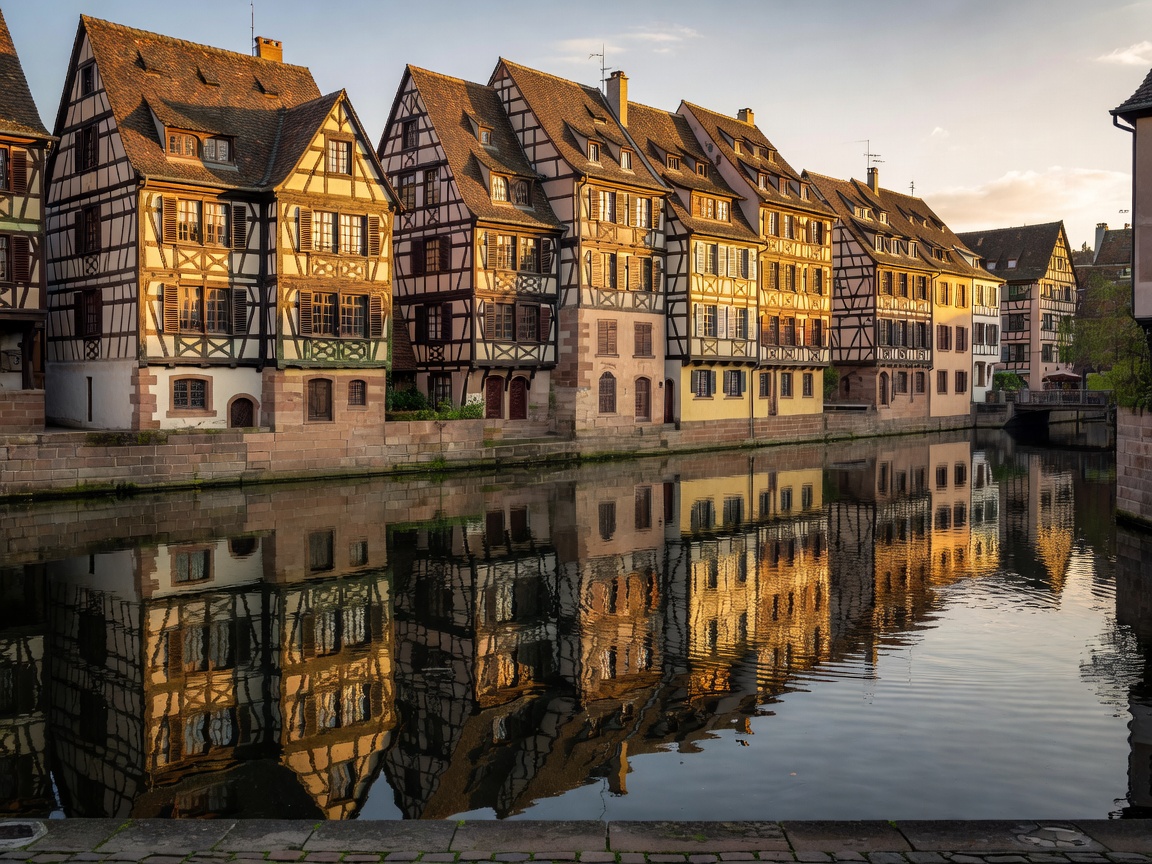
Contrasting France’s Eastern and Western Frontiers
While centralized French political power developed in the Paris basin, France's cultural richness lies heavily along its frontier territories. Alsace, bordered by the Rhine River and the Vosges mountain range, reflects centuries of shared Franco-German cultural synthesis. Conversely, Normandy faces the English Channel, shaped by Viking settlement, maritime trade, and twentieth-century wartime landings.
1. Strasbourg & the Alsace Architectural Heritage
Strasbourg’s historic core, the Grande Île, is surrounded by arms of the River Ill and anchored by the Cathédrale Notre-Dame de Strasbourg. Built from pink Vosges sandstone, the cathedral's single 142-meter spire stood as the tallest architectural structure in Christendom for over two centuries.
The neighboring district of Petite France features dense concentrations of sixteenth- and seventeenth-century timber-framed (colombage) tanners’ homes, characterized by steeply pitched rooflines designed to cure hides under attic eaves. Beyond the metropolitan center, the Route des Vins d'Alsace links medieval fortified towns such as Riquewihr and Eguisheim along the foothills of the Vosges mountains.
Architectural Note: Colombian Timber Joints
Alsatian timber-framing utilizes oak mortise-and-tenon construction without metal nails, infilled with torchis (wattle and clay) or brickwork. Color codes historically denoted religious denominations or craft guilds.
2. Normandy: Chalk Cliffs, Historic Beaches & Mont-Saint-Michel
Normandy’s coastline unfolds over 600 kilometers, defined by distinct geological formations:
- Côte d'Albâtre (Alabaster Coast): Features towering white Senonian chalk cliffs reaching over 100 meters at Étretat, punctuated by natural marine arches and needle formations (L'Aiguille Creuse).
- Landing Beaches of the 1944 Invasion: Stretches from Sword Beach in the east to Utah Beach on the Cotentin Peninsula. The preserved Mulberry Harbour remains at Arromanches and the scarred bluffs of Pointe du Hoc offer solemn historical resonance.
- Mont-Saint-Michel: A tidal granitic islet in the Couesnon river mouth, crowned by an eighth-century Benedictine abbey ("La Merveille"). Renowned for experiencing Europe’s highest tidal ranges, which reach up to fourteen meters between low and high water.
Comparative Analysis: Eastern Border vs. Western Coast
| Dimension | Alsace (Strasbourg Basin) | Normandy (Coastal Corridor) |
|---|---|---|
| Prevailing Climate | Semi-continental; crisp winters, hot sunny summers | Oceanic; frequent marine cloud cover, mild winters, high humidity |
| Primary Material Vernacular | Pink Vosges sandstone, oak timber frames, clay tiles | Caen limestone, flint walls, thatch, chalk masonry |
| Transit Accessibility | TGV Est Européen (1h 46m from Paris Gare de l'Est) | TER/Nomad rail from Gare Saint-Lazare and Montparnasse (2–3h) |
| Signature Landscape | Vosges foothills, terraced hillside vineyards | Bocage hedgerows, open chalk sea cliffs, tidal estuaries |
| Culinary Heritage | Riesling, Choucroute, Munster cheese, Kugelhopf | Cider, Calvados, Camembert de Normandie, salt-marsh lamb |
Pros & Cons of Frontier Travel
Merits
- Both regions boast exceptionally distinct cultural identities differing sharply from Paris.
- Strasbourg offers exemplary tramway infrastructure and cycle path networks.
- Normandy provides deep twentieth-century historical memory combined with raw coastal nature.
Drawbacks
- Normandy weather changes unpredictably; waterproof outerwear is necessary year-round.
- Alsace wine villages can experience heavy tourist coach arrivals during autumn harvest.
- Mont-Saint-Michel access requires substantial walking across extended pedestrian causeways.
Practical Recommendations for Combined Itineraries
Because Alsace sits on France’s eastern boundary and Normandy on the northwestern seaboard, combine them via high-speed transit via Paris rather than attempting a grueling cross-country automobile transfer. Allow at least three dedicated nights in Strasbourg to explore both the European Parliament district and wine towns, and a minimum of three nights in Bayeux or Honfleur for Normandy's historical and coastal perimeter.